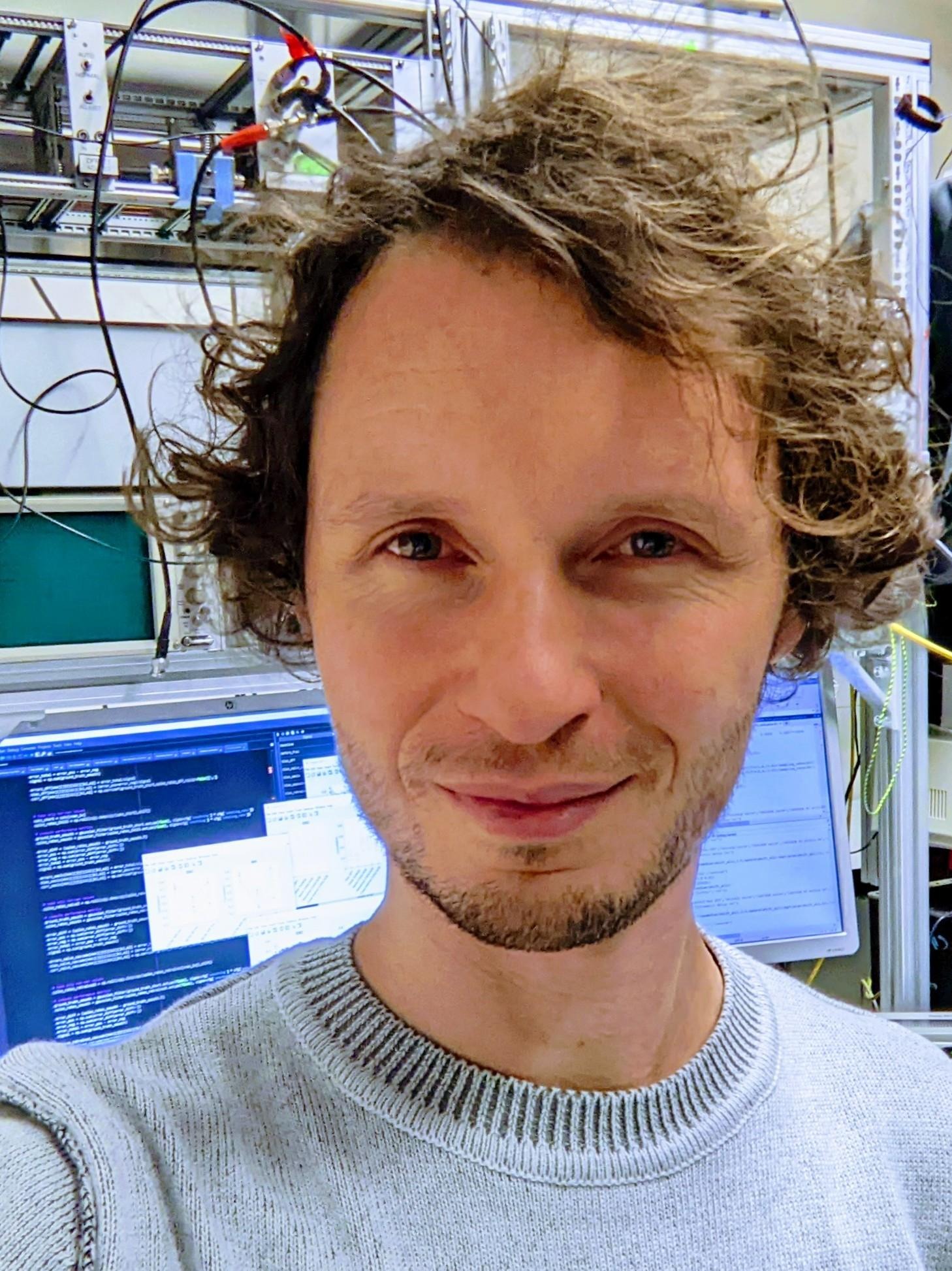
Junior Group Peter Rupprecht
Unraveling subcellular processing in astrocytes and neurons in vivo
Individual cells are the basic organizing units of life. In its most basic form, a cell directly senses and acts upon the environment. In the brain, in contrast, a cell is embedded in a dense neural network. Therefore, to understand the brain, we need to study both the emergent behavior of the complex neural system – the population activity – and the organizing principles that underlie this behavior at the level of individual cells. To study subcellular processes in neurons and astrocytes and how they are embedded in brain-wide circuits, our group employs and continually improves two-photon microscopy for calcium imaging in hippocampus, closed-loop behavioral paradigms, large-scale imaging of cleared brain tissue, and single-cell labeling and perturbations in vivo. Key components of our work are careful experimental design as well as in-depth data analysis rather than large-scale experiments or screens. We believe that such well-thought-out experiments and analyses are ideally suited to tackle the most challenging problem in neuroscience: to understand individual cells and how they integrate signals from local and brain-wide circuits.
Peter Rupprecht studied physics and biology at the University of Bayreuth (Germany) and the ENS Lyon (France). After his diploma in physics in 2013, he worked on computational modeling of neuronal circuits with Prof. Rainer Friedrich and on optical engineering of microscopes for neuroscience with Prof. Alipasha Vaziri. In 2014, he continued as a PhD student with Rainer Friedrich in Basel, where he used optical engineering, calcium imaging, and two-photon targeted patch clamp to dissect the olfactory circuits of zebrafish. Since 2019, he has been a postdoc in the lab of Prof. Fritjof Helmchen at the University of Zürich. There, he developed deep learning methods for the interpretation of calcium imaging data and employed calcium imaging to study the role of astrocytes and neurons during behavior in mice. In 2023, he started his own research group in the Helmchen lab, supported by an SNF Ambizione fellowship.
Open positions: We can offer several potential projects for Master’s students, mostly related to data analysis. The topics will be the analysis of astrocytic calcium imaging data or the improvement of deep learning-based algorithms for spike inference (see Research Interests).